(978) 774-4330

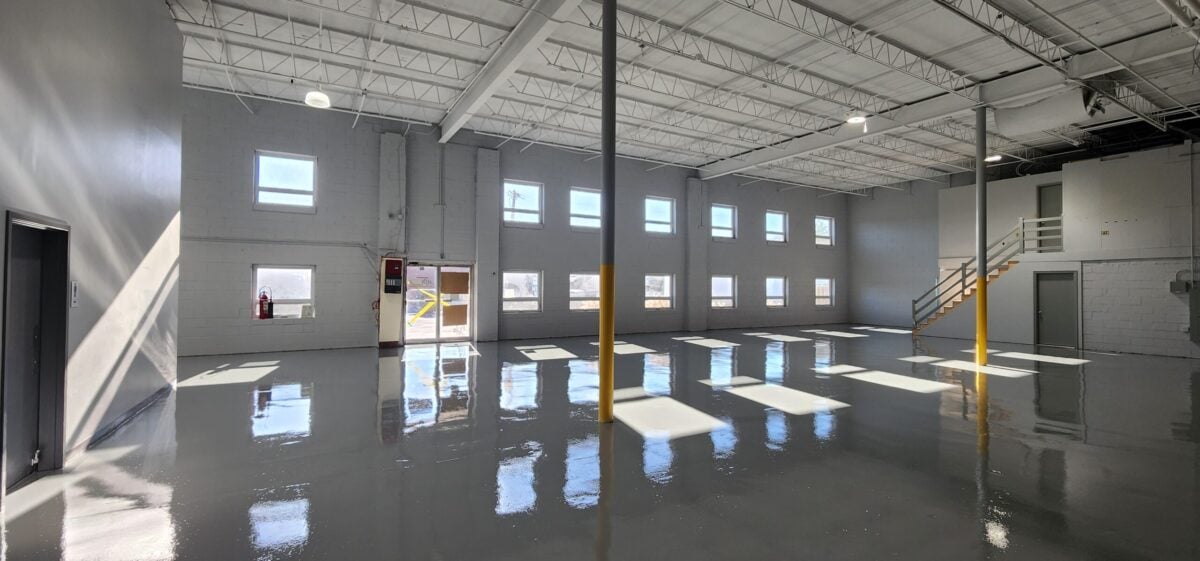
Raw concrete is strong enough to carry the weight of an industrial facility but not built to resist what that facility puts on its surface every day. Oil, chemicals, forklift traffic, dropped tools, and aggressive cleaning all degrade unprotected concrete faster than most facility managers expect. A concrete epoxy floor solves that problem by converting a porous, vulnerable substrate into a sealed, durable, and chemically resistant surface built to perform under real operational conditions. For industrial facilities and commercial properties in Boston, MA and surrounding areas, where the margin for floor-related downtime is thin, the difference between a coated and uncoated floor is measurable in years of service life. Facilities that rely on epoxy systems designed for the demands of industrial concrete consistently outperform those that leave concrete bare or apply insufficient protection.
Here is what you will learn in this guide:
- Why industrial concrete floors need epoxy coating to perform at full capacity
- The 8 most valuable benefits of concrete epoxy floors in industrial spaces in 2026
- What the installation process looks like from substrate preparation through topcoat
- How to choose the right epoxy system specification for your facility type
- What Boston, MA and surrounding areas industrial operators should know before specifying or recoating a floor
Why Industrial Concrete Needs Epoxy Resin Protection to Perform

Concrete is one of the most durable construction materials available, but its raw form has meaningful limitations in industrial environments. It is porous, which means it absorbs oil, chemicals, and moisture on contact. It produces dust from surface wear, which contaminates products, equipment, and air quality. It provides no inherent slip resistance in wet conditions. And it has no resistance to the chemical attack from the fluids, solvents, and cleaning agents that industrial operations routinely put on floor surfaces.
A concrete epoxy floor addresses all of those limitations simultaneously. The epoxy system seals the surface pores, eliminates concrete dust, provides a cleanable and chemically resistant surface layer, and can be formulated with anti-slip aggregate for traction in wet or oily environments. For industrial facilities in Boston, MA and surrounding areas operating under OSHA requirements, food safety regulations, or pharmaceutical compliance standards, an epoxy-coated floor is not a cosmetic upgrade. It is a functional requirement. Here is what properly applied epoxy delivers that bare concrete cannot:
- Surface Impermeability: Epoxy seals the porous concrete surface against liquid penetration, preventing oil, chemical, and moisture absorption that degrades both the slab and the products and equipment stored on it.
- Dust Elimination: Uncoated concrete sheds surface dust continuously under foot and vehicle traffic. Epoxy bonds the surface particles into a solid film that eliminates concrete dust as an air quality and contamination concern.
- Chemical Protection: Industrial cleaning agents, process fluids, lubricants, and incidental spills attack unprotected concrete. Epoxy systems formulated for the specific chemical exposure profile of the facility provide a measurable resistance barrier.
- Safety and Compliance: Anti-slip aggregate systems, high-visibility colors, and zone marking integration help facilities meet OSHA walking-working surface requirements and internal safety standards.
- Extended Slab Life: A concrete slab that is never protected degrades from the surface down. Epoxy preserves the substrate and significantly extends the useful life of the structural concrete beneath it.
8 Benefits for Industrial Spaces in 2026
The benefits below reflect both the technical performance of concrete epoxy floors and the operational advantages they deliver in active industrial environments. Each addresses a real-world problem that facilities without epoxy protection consistently face.
1. Superior Impact and Abrasion Resistance
Industrial floors face mechanical abuse that residential and commercial floors do not. Dropped tools, pallet impacts, steel wheel traffic, and dragged materials all work against the floor surface on a daily basis. High-build epoxy systems applied at adequate dry film thickness absorb this abuse without fracturing or delaminating, protecting the concrete substrate from the progressive damage that eventually requires costly slab repair.
- 100 percent solids epoxy systems applied at 15 to 25 mils dry film provide meaningful impact absorption
- Broadcast aggregate systems add surface hardness that improves abrasion resistance beyond smooth-troweled epoxy
- Epoxy mortar systems at 125 mils or more are specified for the highest-impact industrial zones
2. Chemical Resistance Tailored to the Facility
Not all epoxy systems offer the same chemical resistance, and specifying the right chemistry for the actual exposure profile of the facility is one of the most important decisions in a concrete epoxy floor project. Standard 100 percent solids epoxy performs well against petroleum products, mild acids, and most cleaning agents. Novolac epoxy systems provide enhanced resistance to strong acids and solvents. Urethane-modified epoxy or full urethane cement systems handle thermal cycling and aggressive alkaline cleaning programs that standard epoxy cannot.
- Request a manufacturer chemical resistance chart for the specific chemicals present in the facility before finalizing system selection
- Food processing facilities require systems compatible with USDA and FDA cleaning protocols, not generic industrial epoxy
- Chemical resistance is only valid at the specified dry film thickness. Thin applications reduce resistance even with the correct chemistry
3. Seamless, Hygienic Surface for Cleanability
Joints, grout lines, and surface pores in uncoated concrete harbor bacteria, mold, and contamination that routine cleaning cannot fully address. Seamless epoxy floor systems eliminate those harborage points by creating a continuous, non-porous surface from wall to wall. In facilities where cleanliness is a regulatory requirement, a seamless epoxy surface is one of the most effective tools available for meeting sanitation standards consistently.
For industrial operations in Boston, MA and surrounding areas in food production, pharmaceutical manufacturing, or medical device assembly, seamless floor systems are frequently a compliance requirement rather than an optional upgrade.
- Coved base details extend the seamless system up the wall to eliminate the floor-to-wall joint
- Seamless surfaces support effective cleaning with auto-scrubbers, mops, and high-pressure wash-down equipment
- Color contrast between field and coved base makes cleaning verification easier in high-hygiene environments
4. Enhanced Light Reflectivity
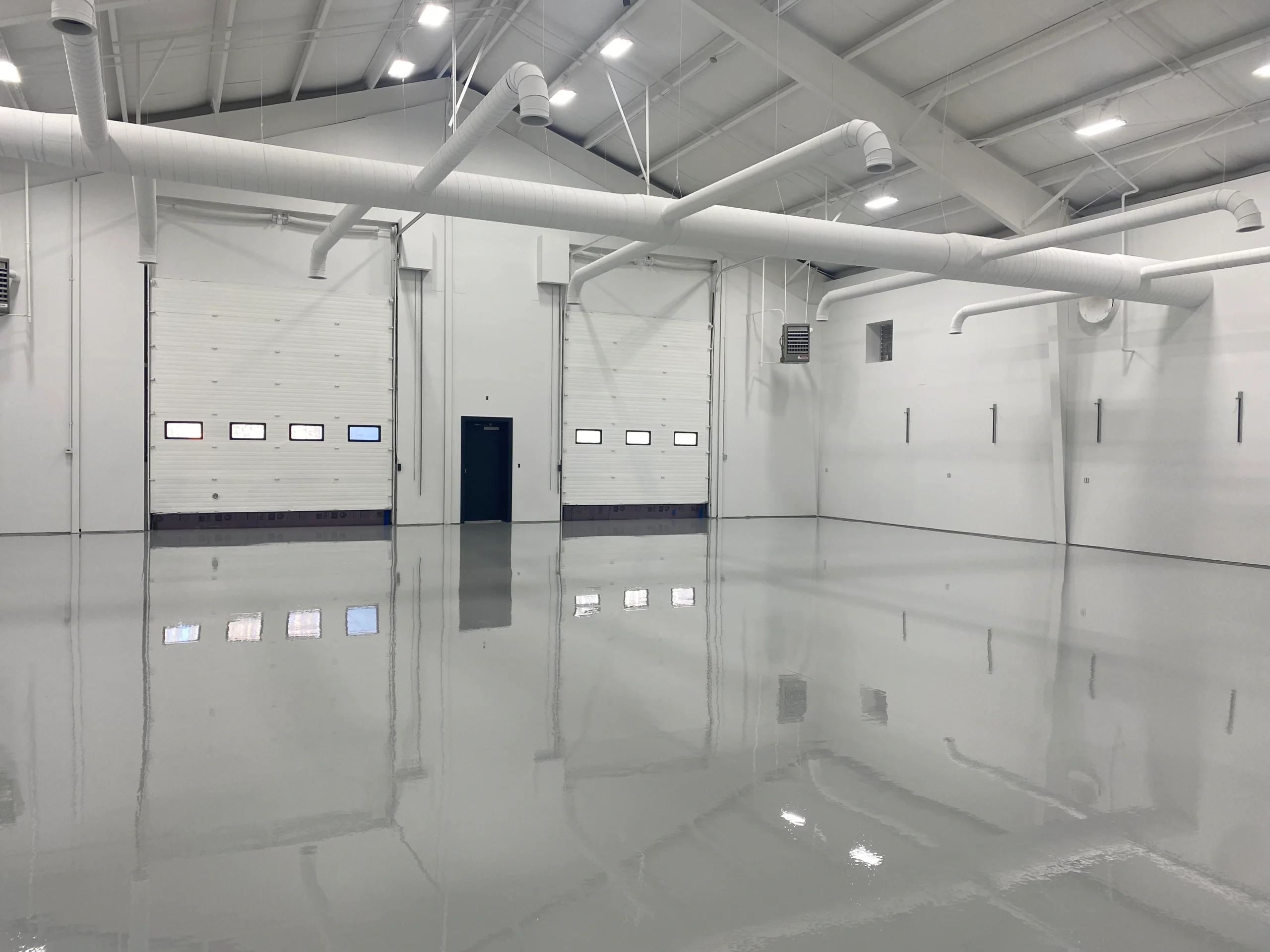
Industrial facilities are often large, tall, and not particularly well-lit relative to the square footage they cover. Light-colored epoxy floor systems reflect ambient light back into the space, effectively amplifying the output of existing lighting infrastructure without adding fixtures. In practical terms, this can meaningfully improve visibility at workstations, in aisle ways, and in any area where tasks require adequate light for accuracy and safety.
- Light gray, off-white, and beige epoxy systems provide the strongest light reflectance values
- Improved light reflectivity contributes to worker comfort and reduces eye strain over long shifts
- Upgraded floor lighting performance is achievable without electrical infrastructure investment when a reflective epoxy system is specified
5. Moisture Vapor Management
Moisture vapor transmission from within the concrete slab is one of the most underestimated threats to industrial floor coating performance and to the equipment and products stored on the floor. Water vapor migrating upward through the slab can cause epoxy delamination, osmotic blistering, and surface degradation that undermines the entire coating system. Proper specification of a concrete epoxy floor includes moisture vapor emission testing before installation and the use of a moisture-tolerant primer or vapor mitigation barrier when test results indicate elevated emission levels.
- ASTM F1869 calcium chloride testing and F2170 in-situ probe testing are the standard methods for quantifying moisture vapor emission before coating
- Moisture-tolerant epoxy primers maintain adhesion at emission levels up to 10 pounds per 1,000 square feet per 24 hours
- Full vapor barrier systems are specified when emission levels exceed what primer alone can address
6. Rapid Return to Service with Advanced Chemistry Options
Traditional epoxy systems require 24 to 72 hours of cure time before light traffic and up to seven days before heavy equipment can return to the coated surface. For industrial facilities in Boston, MA and surrounding areas that operate on tight production schedules, that cure window is a significant operational constraint. Polyaspartic and polyurea topcoat systems applied over an epoxy base coat reduce that return-to-service window to as little as 6 to 12 hours under optimal conditions, making them increasingly popular for planned maintenance shutdowns where minimizing downtime is a priority.
- Polyaspartic topcoats achieve full cure significantly faster than standard aromatic epoxy under equivalent temperature and humidity conditions
- Fast-cure systems allow phased installation in occupied facilities with minimal disruption to adjacent operations
- Cure time should always be measured from application under actual site temperature and humidity, not manufacturer best-case figures
7. Long Service Life and Reduced Lifecycle Cost

A correctly specified and properly installed concrete epoxy floor in an industrial environment should deliver seven to twelve years of service before a maintenance recoat is needed, and the recoat itself restores the system without requiring full removal and reinstallation. Over a fifteen-year horizon, a single properly installed epoxy system with one maintenance recoat is almost always more economical than repeated applications of lower-cost, shorter-life products applied to an inadequately prepared surface.
- Maintenance recoats applied before the existing system wears through to concrete restore protection at a fraction of full installation cost
- Documented service life data from comparable facilities in similar operating environments is the most reliable basis for lifecycle cost modeling
- System longevity is directly tied to preparation quality and installed dry film thickness, not product cost alone
8. Safety Marking Integration and Zone Definition
Concrete epoxy floor systems are the natural foundation for integrated safety marking programs. Floor zone markings, traffic lanes, pedestrian corridors, equipment boundaries, and hazard zones can all be incorporated into the epoxy system during installation using contrasting color epoxy or applied as a secondary step after the base system has cured. Integrating markings into the coating system rather than applying them on top of uncoated concrete provides significantly longer marking life and more consistent adhesion.
- OSHA requires clearly marked aisles and passageways in facilities where industrial trucks operate
- Zone color coding systems for safety, storage, and traffic management are most effective when applied within the same epoxy system rather than painted on top of it
- Line marking durability is directly tied to the condition and adhesion quality of the surface beneath it
What the Installation Process Actually Involves
Understanding what a professional concrete epoxy floor installation looks like helps facility managers plan effectively and evaluate contractor proposals with confidence. The process is more involved than applying paint, and the steps that are most often cut short by unqualified contractors are the ones that determine whether the system performs as specified.
Substrate Assessment and Testing
Before any product touches the floor, a professional crew assesses the concrete substrate for contamination, moisture vapor emission, surface hardness, existing coating condition, and crack or joint issues. This assessment drives product selection and preparation method decisions. Skipping it leads to system failures that cannot be traced back to the product because the root cause was always the substrate.
Mechanical Surface Preparation
Shot blasting is the preferred preparation method for most industrial concrete epoxy floor applications because it mechanically profiles the surface, removes contamination, and opens the concrete pore structure for maximum adhesion in a single pass. Diamond grinding is used for edge work and areas inaccessible to blast equipment. The ICRI surface profile target for the specified system should be documented and achieved before primer application begins.
Primer Application
The primer coat penetrates the prepared concrete surface and establishes the adhesion foundation for the build coats above it. Primer selection should be matched to the substrate condition, with moisture-tolerant formulations used where vapor emission testing indicates elevated moisture. Applying a standard primer over a high-moisture slab is one of the most common causes of industrial epoxy floor failure in the New England climate.
Build Coat and Topcoat Application
Build coats establish the dry film thickness that determines the system’s mechanical and chemical resistance performance. Each coat should be applied within the manufacturer’s recoat window to ensure inter-coat adhesion. The topcoat provides the final surface protection layer and, in UV-exposed environments, should be an aliphatic or polyaspartic formulation that resists yellowing and gloss loss from sunlight exposure.
Choosing the Right Epoxy System for Your Facility Type

Not every industrial facility needs the same concrete epoxy floor specification, and matching the system to the actual operating environment is what separates a floor that performs for a decade from one that requires remediation within the first two years.
| Facility Type | Recommended System | Primary Performance Requirement |
| General warehouse | 100% solids epoxy, 2 coat | Abrasion resistance, dust elimination |
| Food processing | Urethane cement or novolac epoxy | Chemical resistance, thermal shock, seamless surface |
| Manufacturing with forklifts | High-build broadcast epoxy | Impact resistance, anti-slip, zone marking |
| Pharmaceutical | Seamless epoxy or urethane | Cleanability, hygienic surface, compliance |
| Auto service and fleet maintenance | Broadcast epoxy or polyaspartic | Chemical resistance, rapid cure, oil resistance |
| Parking and vehicle storage | Polyurea or moisture-tolerant epoxy | Freeze-thaw resistance, tire wear, moisture management |
Put the Right System on Your Industrial Floor
A concrete epoxy floor is one of the highest-return investments an industrial facility can make in its physical infrastructure. It protects the structural slab, supports compliance and safety programs, reduces ongoing maintenance costs, and gives the facility a surface that functions as well in year eight as it did on day one when it is properly specified and installed.
McLean Company has applied concrete epoxy floor systems to industrial and commercial facilities across New England for decades. We bring the substrate assessment discipline, preparation standards, and installation expertise that demanding environments require. If your facility floor is overdue for protection or a current system is underperforming, we are ready to assess it and tell you exactly what it needs.
Contact us today to schedule a site visit and get a concrete epoxy floor specification built around your facility’s actual operating conditions.