(978) 774-4330


Water is the most persistent and most destructive force acting on commercial buildings in New England. It does not need a major storm event to cause significant damage. It migrates through hairline cracks, wicks through porous masonry, accumulates behind failed caulk joints, and works its way into wall assemblies where it causes corrosion, mold, and structural deterioration over years before the evidence becomes visible inside the building. Waterproofing commercial building envelopes is not a remediation strategy. It is a proactive investment that protects the structure, the interior systems, and the occupants from the consequences of water infiltration. For commercial property owners in Worcester, MA and surrounding areas, where freeze-thaw cycling accelerates moisture damage faster than in more temperate climates, building envelope protection is a year-round maintenance priority. The same discipline that defines exterior coating systems designed to keep water out of commercial masonry and concrete is what makes a waterproofing program actually work over time.
Here is what you will learn in this guide:
- Why commercial building waterproofing is a long-term structural investment, not a quick fix
- The 7 most proven waterproofing solutions for commercial buildings in 2026
- Which building components are most vulnerable to water infiltration and why
- How to assess your building’s current waterproofing condition and identify gaps
- What Worcester, MA and surrounding areas property owners should prioritize when planning a waterproofing scope
Why Commercial Waterproofing Is a Non-Negotiable Priority for Building Owners

Water infiltration in a commercial building does not announce itself on arrival. It arrives quietly through a failed caulk joint, a hairline crack in the parapet, or a porous section of brick that has lost its original density over decades of freeze-thaw cycling. By the time water damage becomes visible on interior walls, ceilings, or floor surfaces, it has typically been present in the wall assembly for months or years, degrading insulation, corroding embedded steel, and providing the sustained moisture environment that mold requires to establish itself.
The repair costs associated with water damage that was allowed to progress are significantly higher than the cost of the waterproofing measures that would have prevented it. Remediation of mold in a commercial building, repair of corroded structural reinforcement, and replacement of water-damaged interior finishes routinely runs into tens or hundreds of thousands of dollars on projects that started with a failed caulk joint that could have been addressed for a fraction of that cost. For building owners in Worcester, MA and surrounding areas, the case for proactive waterproofing investment is straightforward. Here is what a properly maintained building envelope waterproofing program protects:
- Structural Integrity: Moisture infiltration into concrete and masonry accelerates carbonation and chloride attack on embedded reinforcing steel, eventually causing spalling and structural capacity loss that requires major remediation.
- Interior Systems and Finishes: Water that penetrates the building envelope damages insulation, drywall, ceiling systems, electrical components, and interior finishes, all of which are expensive to replace and disruptive to repair in occupied commercial buildings.
- Indoor Air Quality: Sustained moisture in wall assemblies creates the conditions for mold and mildew growth that affects building occupant health and creates regulatory and liability exposure for building owners.
- Energy Performance: Wet insulation loses its thermal resistance, increasing heating and cooling loads and energy costs for the building. A dry, properly waterproofed building envelope performs significantly better thermally than a compromised one.
- Asset Value: A commercial building with documented water infiltration problems is worth less and harder to finance, lease, or sell than a building with a well-maintained, watertight envelope. Proactive waterproofing protects the asset value of the investment.
7 Proven Commercial Waterproofing Solutions for Commercial Buildings in 2026
The solutions below represent the most effective and most widely specified approaches to commercial waterproofing across the building envelope components most vulnerable to water infiltration. Each addresses a specific failure mode or exposure condition that commercial buildings in New England regularly face.
1. Elastomeric Coatings for Masonry and Concrete Exterior Walls
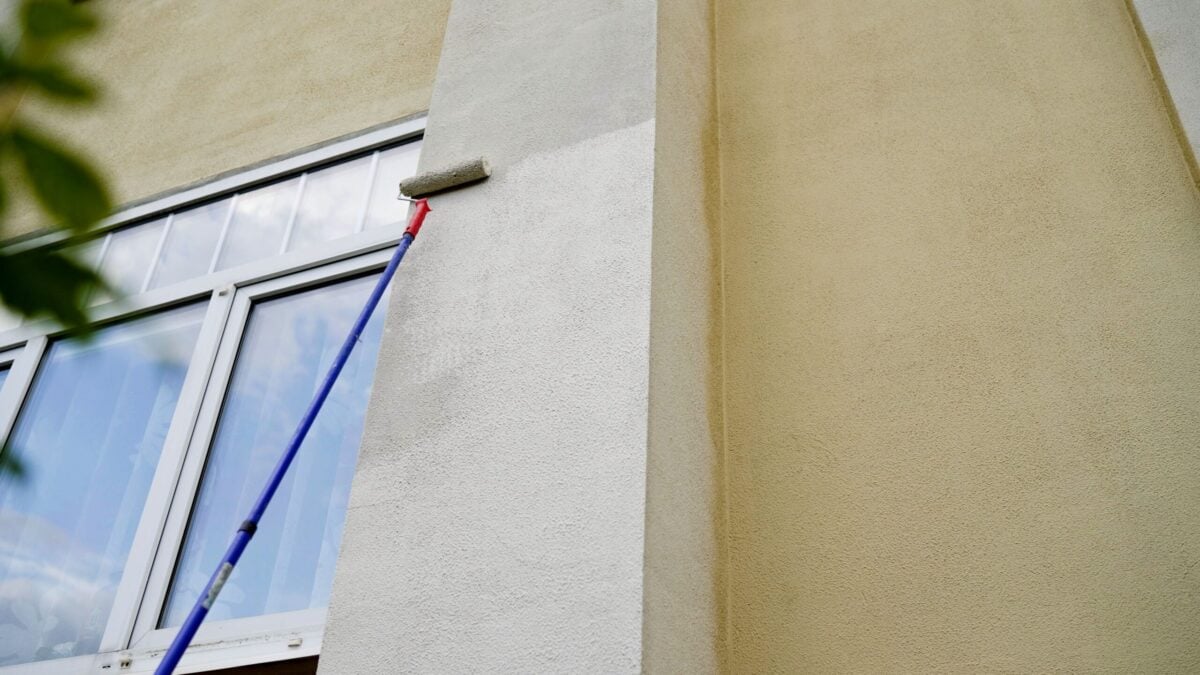
Elastomeric coatings are the most broadly applicable solution for above-grade masonry and concrete exterior walls. These thick-film, flexible coating systems form a continuous waterproof membrane across the surface that bridges hairline cracks, resists wind-driven rain, and remains intact through the thermal cycling that causes rigid coatings to crack and fail over time.
Applied at significantly greater film thickness than standard exterior paint, elastomeric systems are engineered to span dynamic substrate movement rather than fracturing as the building expands and contracts with temperature changes. For commercial masonry buildings in Worcester, MA and surrounding areas, where freeze-thaw cycling puts extreme stress on both the substrate and any coating applied to it, elastomeric systems consistently outperform conventional paint over a ten to twenty year service horizon.
- Crack bridging capability allows elastomeric systems to span hairline cracks up to 1/16 inch without rupturing
- Vapor-permeable formulations allow moisture vapor from inside the wall assembly to escape while blocking liquid water entry from the exterior
- UV-stable acrylic elastomeric systems maintain film integrity and waterproofing performance significantly longer than standard exterior latex under New England exterior exposure conditions
2. Penetrating Silane and Siloxane Sealers for Porous Masonry
Penetrating sealers based on silane or siloxane chemistry provide a different approach to masonry waterproofing that is particularly appropriate for historic buildings, natural stone, and brick surfaces where a visible surface coating would compromise the appearance of the substrate. Rather than forming a film on the surface, these materials penetrate into the pore structure of the masonry and react chemically to create a hydrophobic lining within the pores that causes water to bead and run off rather than being absorbed.
Unlike film-forming coatings, penetrating sealers do not change the visual character of the masonry surface, do not peel or delaminate, and do not trap moisture within the wall assembly if applied correctly. They are vapor permeable, meaning the wall can still breathe, and they reduce water absorption by 80 to 95 percent in properly applied systems on compatible substrates.
- Silane penetrates deeper into dense substrates and is preferred for concrete and hard brick where maximum penetration depth is needed
- Siloxane has larger molecules that penetrate less deeply but provide excellent performance on more porous brick and softer stone substrates
- Silane-siloxane blends combine the penetration depth of silane with the broader surface coverage of siloxane and are the most versatile option for mixed masonry substrates
3. Caulking and Joint Sealant Systems

Every commercial building envelope has deliberate and incidental gaps: expansion joints, control joints, window perimeters, door frames, penetrations for mechanical and electrical systems, and the interfaces between different cladding materials. These gaps are the most common entry points for water in commercial buildings because they are present everywhere, they are subject to movement stress, and their sealants have a finite service life that is often shorter than the surrounding materials.
A comprehensive joint sealant program for a commercial building in Worcester, MA and surrounding areas involves inspecting every joint and penetration in the envelope, removing failed or incompatible existing sealant, preparing the joint substrate, installing appropriate backer rod to control sealant depth, and applying a sealant product with the right chemistry and movement capability for each joint type.
- Polyurethane sealants are the most commonly specified choice for commercial building expansion and control joints due to their high movement capability and paintability
- Silicone sealants offer superior UV and thermal resistance for exposed joints in high-movement or high-temperature applications
- Hybrid silicone-polyurethane formulations provide a balance of movement capability, adhesion, and paintability for applications where both properties are needed
- Sealant service life in commercial building applications typically ranges from seven to fifteen years depending on product type, joint design, and exposure conditions
4. Below-Grade Foundation Waterproofing and Drainage Systems
Below-grade building components, including foundation walls, basement slabs, elevator pits, and below-grade parking structures, face hydrostatic pressure from groundwater that above-grade systems are not designed to resist. Foundation waterproofing on commercial buildings requires sheet-applied or fluid-applied membranes rated for hydrostatic conditions, drainage systems to manage groundwater before it reaches the membrane, and protection board to prevent membrane damage during backfill operations.
The selection between sheet-applied and fluid-applied membrane systems depends on the geometry of the substrate, the severity of the hydrostatic pressure condition, and whether the application is new construction or remediation of an existing below-grade space. Both system types have distinct advantages and limitations that should be evaluated by a qualified specifier before product selection is finalized.
- Sheet-applied membranes provide consistent thickness and reliable performance on simple flat and curved surfaces but require more skilled installation at complex intersections and penetrations
- Fluid-applied membranes conform to complex geometry more easily but require careful quality control to ensure consistent film thickness across the entire application area
- Drainage composite layers installed against the membrane reduce hydrostatic pressure by directing groundwater to drainage systems before it can accumulate against the membrane
5. Parapet and Roof-to-Wall Transition Waterproofing
Parapets and the transitions between the roof membrane and the vertical building envelope are among the highest-risk locations for water infiltration in commercial buildings. These areas are exposed to weather from multiple directions, subject to significant thermal movement, and often detail complex intersections between the roof system, the wall system, and the coping or cap flashing. When any component of this assembly fails, water has a direct path into the building at the top of the wall, where it can track downward through the entire wall assembly before becoming visible at lower levels.
Parapet waterproofing scope typically includes inspection and replacement of coping cap flashing, application of fluid-applied waterproofing membrane at the roof-to-wall transition, installation of through-wall flashing at critical interfaces, and elastomeric coating or sealant treatment of the parapet face and top surface.
- Coping cap flashing is the single most critical detail in parapet waterproofing. Failed or improperly lapped coping allows water direct access to the top of the wall assembly
- Through-wall flashing at window heads and shelf angles must be intact and properly sloped to the exterior to direct infiltrated water back out of the wall rather than allowing it to track inward
- Elastomeric membrane applied to the parapet top and inside face provides a continuous waterproof layer that protects the highest-exposure section of the building envelope
6. Window and Curtain Wall System Maintenance
Windows and curtain wall systems in commercial buildings are complex assemblies with multiple waterproofing components that all require periodic inspection and maintenance to remain effective. The gaskets that seal glass to frame, the sealants at perimeter interfaces between the window system and the surrounding wall, the drainage paths designed to remove any water that does enter the frame, and the thermal break details all contribute to the overall water resistance of the assembly.
Curtain wall systems in particular have sophisticated drainage strategies built into the frame design that rely on drainage holes remaining clear and properly sloped to function. When debris accumulates in curtain wall drainage channels or when frame sealants at intermediate joints fail, water that enters the system is redirected inward rather than outward, which causes infiltration that can appear far from the actual entry point.
- Perimeter sealant at window and curtain wall frames should be inspected annually and replaced on a seven to ten year cycle depending on the product and exposure conditions
- Glazing gasket inspection and replacement is a separate scope from perimeter sealant and should be evaluated by a glazing specialist as part of a comprehensive envelope assessment
- Drainage weep holes in window frames and curtain wall systems should be inspected and cleared annually to maintain the drainage function they were designed to provide
7. Concrete and Masonry Crack Injection
Active cracks in concrete foundation walls, parking structures, and above-grade concrete building components allow direct water infiltration and are the starting point for progressive concrete deterioration. Crack injection with polyurethane or epoxy materials stops active infiltration and restores the continuity of the concrete section, preventing further water entry and limiting the chloride and carbonation exposure that drives ongoing corrosion of embedded reinforcement.
Polyurethane injection is appropriate for actively leaking cracks where the goal is to stop water infiltration. The material reacts with moisture to expand and fill the crack. Epoxy injection is appropriate for structural cracks in dry concrete where restoring the full tensile strength of the section is the objective. Selecting the wrong material for the crack condition produces either a material that will not cure properly or a structural repair that does not address the ongoing water infiltration.
- Crack injection is a remediation measure, not a substitute for addressing the root cause of cracking. Structural movement, settlement, or alkali-silica reaction that is causing the crack will continue to produce new cracks if not addressed
- Injection ports should be spaced based on the depth of the crack and the viscosity of the injection material to ensure full penetration through the section thickness
- Post-injection monitoring confirms that the crack has been fully sealed and identifies any areas where additional injection is needed
Assessing Commercial Properties for Waterproofing Gaps and Building Codes Compliance

A commercial building waterproofing assessment is the starting point for any proactive waterproofing program. It identifies which components of the building envelope are performing adequately, which are at or approaching end of service life, and which have already failed and are contributing to active water infiltration. For commercial properties subject to local building codes requirements around moisture control and envelope performance, a documented assessment also establishes the baseline record that code compliance and insurance reviews may require.
A thorough assessment covers the entire building envelope from grade to parapet, including all cladding surfaces, joints, penetrations, window perimeters, roof transitions, and below-grade components. It documents existing conditions with photographs, identifies failure modes, and prioritizes remediation by risk level.
Visual Inspection
Visual inspection covers all accessible envelope surfaces for evidence of water infiltration, coating failure, joint sealant deterioration, cracks, biological growth, efflorescence, and staining that indicates chronic moisture presence. While visual inspection is the starting point, it does not reveal subsurface moisture conditions or the condition of components concealed within the wall assembly.
Water Testing
Controlled water testing using AAMA 501 or similar test methods applies water to specific envelope locations under controlled pressure to identify infiltration points that are not apparent through visual inspection alone. Water testing is particularly valuable for isolating infiltration sources in complex curtain wall and window systems where the entry point may not be close to where water appears on the interior.
Infrared Thermography for Air Quality and Moisture Detection
Infrared thermography identifies areas of elevated moisture within wall assemblies by detecting the thermal anomalies associated with wet insulation or substrate. It is a non-destructive diagnostic tool that allows assessment of subsurface moisture conditions without opening the wall assembly. In buildings where sustained moisture infiltration has progressed to the point where air quality concerns are present, thermography helps locate the moisture source driving the problem and prioritize remediation by severity. This method is increasingly standard practice in comprehensive commercial building envelope assessments in Worcester, MA and surrounding areas.
Plan Your Building Waterproofing Before the Next Season Arrives
Water does not wait for a convenient time to find the gaps in a commercial building envelope. The freeze-thaw cycles of a New England winter accelerate every existing crack, every failed joint, and every area of compromised masonry into a larger, more expensive problem. The right time to assess and address waterproofing deficiencies is before the conditions that will exploit them arrive, not after the damage is already visible inside the building.
McLean Company has been working with commercial building owners across New England to assess, specify, and apply waterproofing systems that protect building envelopes from the conditions New England actually creates. We understand the substrate challenges, the seasonal constraints, and the coating and sealant systems that perform in this climate, and we deliver work that is specified correctly and applied with the discipline it requires.
Contact us today to schedule a building envelope assessment and find out what your commercial property needs to stay watertight through 2026 and beyond.