(978) 774-4330

Not every concrete slab is ready to coat the moment surface preparation is complete. Some floors have low spots that pool water during cleaning. Some have high spots that create uneven wear across a coating system. Some have surface undulations that make polished concrete look wavy rather than reflective. When the substrate is not flat enough for the intended floor system to perform correctly, applying the coating anyway is the kind of shortcut that produces early failure and the full cost of doing the project again. Self-leveling underlayment is the material that corrects those flatness deficiencies before the coating goes down, and knowing when it is needed, which product is appropriate, and how it has to be installed is what separates a specification that holds up from one that does not. For commercial and industrial property owners in Worcester, MA and surrounding areas, understanding this step in the flooring process protects the investment in everything that goes on top of it. The same foundation discipline that defines durable floor systems for demanding commercial and industrial environments starts with getting the slab right before any coating is applied.
Here is what you will learn in this guide:
- What self-leveling underlayment is and how it works on commercial concrete floors
- When a floor actually requires it before coating versus when other solutions are more appropriate
- The types of self-leveling underlayment products and which applications each suits
- What the installation process involves and what preparation the concrete slab requires first
- What Worcester, MA and surrounding areas facility managers should know before including self-leveling underlayment in a floor project scope
Why Slab Flatness Matters More Than Most Facility Managers Realize
Coating systems are not a remedy for an uneven concrete substrate. They follow the surface they are applied to, which means low spots remain low, high spots remain high, and any undulation in the slab translates directly to the finished floor surface. In a warehouse or distribution center, that unevenness affects forklift stability and load safety. In a retail space with polished concrete, it creates visual distortion in the reflective finish. In a food processing or pharmaceutical facility, low spots that pool liquid create contamination harborage points that the facility’s cleaning program cannot fully address.
The floor flatness standard for a commercial or industrial space is determined by the intended use and, in many cases, by the specific flooring system being applied. High-gloss decorative systems reveal surface irregularities that a matte broadcast aggregate floor would conceal entirely. Forklift-rated distribution center floors have specific F-number flatness requirements that affect vehicle stability at operating speeds. Understanding what the application actually requires, and whether the existing slab meets that standard before coating begins, is the question that determines whether self-leveling underlayment is part of the scope. Here is what addressing slab flatness before coating delivers:
- System Performance: A coating or flooring system applied to a flat, properly prepared substrate performs to its rated specifications for adhesion, wear resistance, and service life. Applied to an uneven substrate, those specifications are compromised from day one.
- Appearance Quality: Decorative floor systems including polished concrete, metallic epoxy, and high-gloss coatings reveal every surface irregularity. Self-leveling underlayment produces the flat, smooth substrate those systems require to look the way they are specified to look.
- Safety and Compliance: Low spots that retain water, surface undulations that affect forklift stability, and transitions that create trip hazards all represent safety and compliance risks that a flat substrate eliminates.
- Cleanability: In food-grade, pharmaceutical, and healthcare environments, a flat floor with no pooling points is a functional requirement for maintaining sanitation standards. Self-leveling underlayment creates that surface where the original slab does not provide it.
- Coating Longevity: Thin-film coating systems applied over high spots wear through faster at those locations because they have less film build at the apex of the irregularity. A flat substrate means consistent film thickness and consistent wear across the entire floor.
6 Situations When Concrete Floors Need Self-Leveling Underlayment Before Coating

Self-leveling underlayment is not a universal pre-coating step. It is a specific solution for specific substrate conditions, and correctly identifying when it is needed, and when alternative approaches are more appropriate, is part of professional floor system specification.
1. Floors with Measurable Low Spots and Pooling Issues
The most common reason self-leveling underlayment is specified on commercial and industrial floors is the presence of low spots where liquid pools during cleaning or wet process operations. These depressions may be the result of original slab placement, differential settlement over time, or surface wear that has developed gradually over years of vehicle and foot traffic.
In facilities where wet processes, wash-down cleaning, or spill containment are operational realities, pooling in low spots is not just an inconvenience. It is a contamination risk, a slip hazard, and a condition that concentrates moisture against the floor coating, accelerating the moisture-related failure modes that degrade adhesion over time. Self-leveling underlayment raises those areas to match the surrounding floor level, eliminating the pooling condition before the coating system is applied.
- The depth and extent of low spots determines whether self-leveling underlayment, localized patching mortar, or a combination approach is the appropriate solution
- Low spots deeper than 1.5 inches typically require a layered pour approach or a specialty high-build underlayment rather than a single standard pour
- Drainage slope requirements in wash-down areas must be maintained when using self-leveling underlayment. The product levels to true horizontal by default, so slope is established through screeding rather than self-leveling flow
2. Floors Being Converted from One Use to a Higher Flatness Standard
Commercial buildings change use over time. A space that operated as a general warehouse may be converted to a food processing facility that requires a flat, seamless floor with coved bases. A retail space being renovated for a polished concrete finish may have a slab that was acceptable for carpet or vinyl tile but does not meet the flatness standard that a high-gloss polish requires.
When a use change triggers a higher floor flatness requirement than the existing slab provides, self-leveling underlayment is the most efficient way to bring the entire floor surface to the required standard without removing and replacing the slab. For commercial property owners in Worcester, MA and surrounding areas managing building conversions or tenant improvements, this application is one of the most common reasons underlayment appears in flooring project scopes.
- Floor flatness for polished concrete is typically specified at FF 35 or higher, which is significantly more demanding than the FF 25 minimum for most general commercial construction
- Facilities converting to food-grade or pharmaceutical use may need to meet specific regulatory standards for floor flatness and surface continuity that the existing slab was not designed to achieve
- Underlayment installed over an existing slab raises the finished floor elevation by the thickness of the pour, which affects door clearances, threshold details, and transitions to adjacent spaces that must be addressed in the scope
3. Floors with Surface Damage Across Large Areas

Localized surface damage, spalling, and deterioration can be addressed with patching mortar on a spot basis. When surface damage is distributed across a significant portion of the floor area, spot patching produces a floor with inconsistent surface texture and elevation that the coating system cannot fully conceal. A skim coat of self-leveling underlayment over the prepared surface creates a uniform substrate that the coating system bonds to consistently across the entire floor.
This application is particularly common in older manufacturing and industrial facilities in Worcester, MA and surrounding areas where decades of vehicle traffic, chemical exposure, and deferred maintenance have left the concrete surface eroded and inconsistent in texture and elevation.
- The existing concrete surface must be mechanically prepared before self-leveling underlayment is applied. Adhesion of the underlayment to a contaminated or sealed surface is not reliable
- Skim coat applications of self-leveling underlayment are typically 1/8 to 1/4 inch in thickness. Thicker applications require standard depth pour products rather than skim coat formulations
- Surface temperature and humidity during application affect the self-leveling flow and cure rate. Application outside the manufacturer’s specified temperature range produces results that do not match the rated performance
4. New Construction Slabs That Did Not Finish to Tolerance
New concrete slabs sometimes do not achieve the specified flatness tolerance during placement and finishing, particularly on large pours where maintaining consistent flatness across the full area is difficult. Rather than waiting for slab replacement or accepting a floor system that will not perform as specified, self-leveling underlayment applied over a cured and prepared new slab can bring the surface to the required standard before the flooring system installation begins.
On new construction, the concrete must reach full strength and be allowed to undergo its initial drying shrinkage before underlayment is applied. Applying underlayment to green concrete produces differential movement between the two materials during curing that causes delamination.
- New concrete slabs should typically cure for a minimum of 28 days before self-leveling underlayment is applied, and moisture vapor emission should be tested before application
- Construction-related contamination including form release agents, curing compounds, and concrete splatter must be fully removed by mechanical preparation before underlayment adhesion is reliable
- On new slabs, the specification for underlayment should be coordinated with the general contractor to ensure that the floor elevation after underlayment installation accounts for door hardware, threshold, and finish floor elevation requirements
5. Floors Over Radiant Heat Systems
Concrete floors with embedded radiant heating systems present a specific challenge for surface preparation and coating. The heating cables or tubes create surface irregularities in the concrete above them, and the thermal cycling of the system causes expansion and contraction that standard concrete patching materials handle poorly. Self-leveling underlayment formulated for radiant heat applications accommodates that thermal movement while producing a flat surface appropriate for the flooring system above.
Underlayment over radiant heat systems must be turned off for a specified period before application and cannot be activated until the underlayment has fully cured, which can take several days depending on pour thickness and ambient conditions.
Here is a strong sixth situation that fits naturally with the existing five and adds a genuinely distinct use case:
6. Floors Receiving Polished Concrete Finishes That Require Absolute Flatness
Polished concrete is one of the most flatness-sensitive floor finishes available in commercial construction. The grinding and polishing process refines the surface but does not correct significant flatness deficiencies. A slab with dips, ridges, or undulations that are within acceptable tolerance for a coated floor will produce a polished surface with visible distortion in the reflective finish, inconsistent aggregate exposure across the floor, and irregular sheen that undermines the entire aesthetic objective.
Self-leveling underlayment applied over a prepared slab before polishing provides the flat, uniform substrate that a high-quality polished concrete finish requires. This application is particularly common in retail, hospitality, and institutional renovation projects where the existing slab condition does not meet the flatness standard that the desired polish level demands.
- Floor flatness for high-gloss polished concrete is typically specified at FF 35 or above, which is significantly more demanding than the construction tolerance of most existing commercial slabs
- Underlayment applied before polishing must be dense, hard, and compatible with diamond tooling. Standard lightweight underlayment products are not appropriate for polished concrete applications because they do not grind and polish consistently with the surrounding concrete matrix
- Color, aggregate size, and surface characteristics of the underlayment affect the finished appearance of the polished surface. Specify underlayment products that the manufacturer confirms are compatible with the polishing process and the desired finish level
Should I now swap in Option 1 (“5 Situations When…”) updated to “6 Situations When Concrete Floors Need Self-Leveling Underlayment Before Coating,” add this new H3, and deliver the full updated blog?
Self-Leveling Underlayment Products: What the Differences Actually Mean
Self-leveling underlayment is not a single product. Different formulations are designed for different application thicknesses, substrate conditions, and finished flooring systems. Selecting the wrong product for the application produces a floor that does not achieve the intended flatness, does not bond reliably to the substrate or the flooring system above it, or fails prematurely under the service conditions it encounters.
- Cement-Based Underlayment: The most common product type for commercial applications. Available in standard and high-build formulations covering application depths from feathered edge to several inches. Compatible with most topical coating systems when properly primed. Appropriate for the majority of commercial floor leveling applications.
- Gypsum-Based Underlayment: Faster drying and lower cost than cement-based products, but significantly more moisture-sensitive. Not appropriate for wet environments, areas with potential moisture exposure, or below-grade applications. Used primarily under resilient flooring and carpet in climate-controlled interior spaces.
- Rapid-Setting Formulations: Cement-based underlayments designed to achieve foot traffic in 2 to 4 hours and coating readiness in 16 to 24 hours. Appropriate for projects with compressed timelines. Require more precise mixing and application because the working time is significantly shorter than standard formulations.
- Moisture-Tolerant and Vapor Barrier Underlayments: Specialty products designed for slabs with elevated moisture vapor emission where standard underlayment would trap moisture and create adhesion problems. These products must be tested and specified against the specific moisture vapor emission rate measured on the project slab.
What the Installation Process Involves and Where It Goes Wrong

Understanding what a correctly executed self-leveling underlayment installation involves helps facility managers evaluate contractor proposals accurately and plan the project timeline realistically. The steps that are most often skipped or rushed are the ones that determine whether the underlayment performs as specified or fails within the first year of the floor system’s service life.
Primer Application
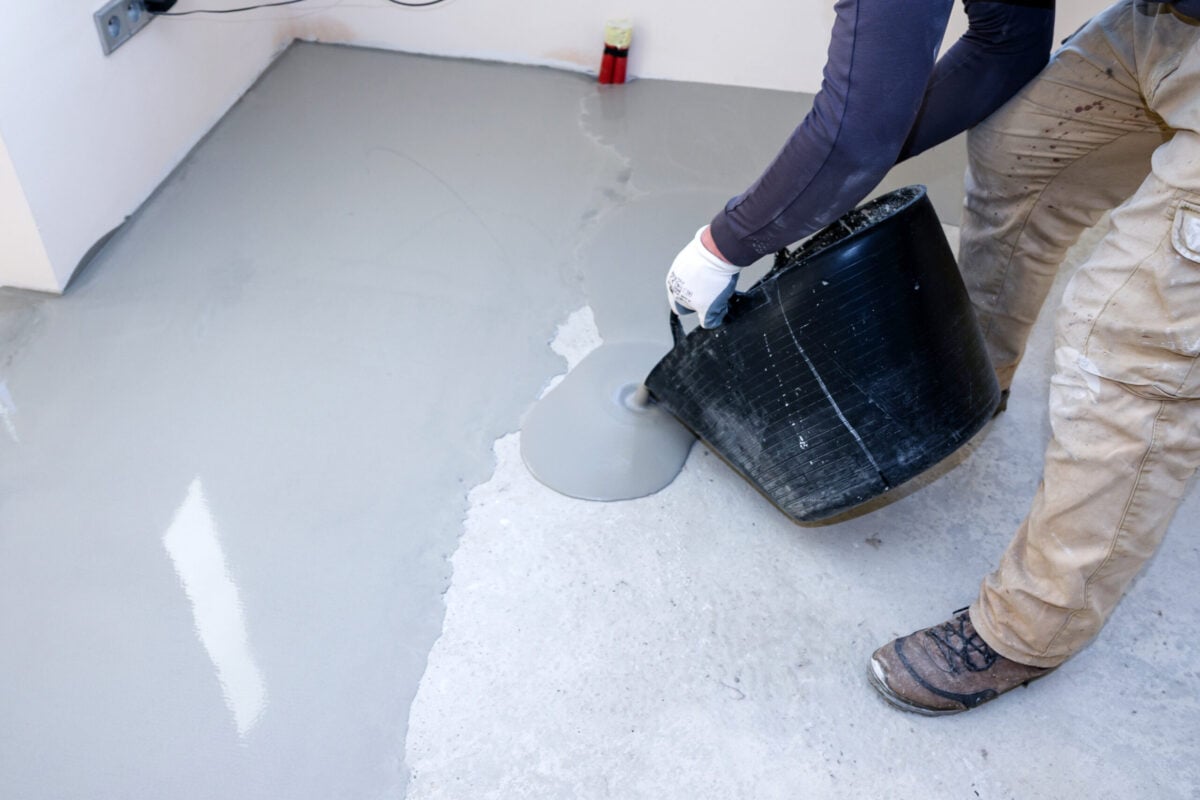
Most self-leveling underlayment products require a primer applied to the prepared concrete surface before the underlayment is poured. The primer seals the surface pores, controls suction, and creates the bond interface between the existing concrete and the underlayment. Applying underlayment without primer to a porous concrete surface causes rapid moisture loss from the product during curing, which results in a weak, crumbly underlayment that does not achieve its rated compressive strength or adhesion.
Mixing and Pour Rate
Self-leveling underlayment is mixed to a specific water-to-powder ratio that produces the self-leveling flow consistency the product is designed for. Too much water produces a weak underlayment with low compressive strength and high shrinkage. Too little water produces a product that does not flow and level correctly. Maintaining consistent mix ratios across an entire pour requires discipline and equipment that can meter water accurately.
Perimeter and Penetration Detailing
Self-leveling underlayment flows to every low point on the floor, including gaps at walls, around column bases, and at floor penetrations. These areas must be sealed before the pour with foam backer rod, tape, or specialized perimeter products to prevent underlayment from flowing under walls or into areas where it is not intended. In Worcester, MA and surrounding areas where older buildings often have irregular perimeter conditions and numerous floor penetrations from equipment and utilities, this detailing step can be time-consuming but is essential for a clean result.
Curing and Moisture Testing Before Coating
Self-leveling underlayment must cure fully before the topical coating system is applied over it. Applying coating over under-cured underlayment traps residual moisture that causes blistering, delamination, and adhesion failure. Moisture vapor emission from the underlayment surface should be tested before the flooring system installation proceeds, using the same ASTM standards applied to the original concrete slab assessment.
Get Your Concrete Floor Flat Before the Coating Goes Down
Self-leveling underlayment is a precision material that requires the right product, correct substrate preparation, accurate mixing, and proper curing management to deliver the flat, bondable surface a commercial or industrial floor coating system requires. When it is specified and installed correctly, it sets up the entire floor system to perform as intended. When it is skipped, rushed, or applied to an inadequately prepared substrate, it creates a failure point that undermines everything applied over it.
McLean Company works with commercial and industrial facility owners across New England to assess substrate conditions, specify the right underlayment and coating systems for each project, and execute the installation with the preparation standards and process discipline that these projects require. If your facility has a floor that is not flat enough for the system you need, we can assess it and tell you exactly what it takes to get there.
Contact us today to schedule a floor assessment and get a clear recommendation on whether self-leveling underlayment belongs in your project scope and what the complete installation would involve.