(978) 774-4330

Concrete floors fail for many reasons, but moisture vapor emission from within the slab is responsible for more commercial flooring failures than almost any other single cause. Epoxy blistering, topcoat delamination, resilient flooring adhesive failure, and coating systems that peel within months of installation are frequently blamed on the product or the installer when the real cause is moisture vapor migrating upward through the concrete and breaking the bond from beneath. Moisture vapor barrier flooring is the category of products and systems designed to stop that process before it starts, and knowing when a floor needs one, which product is appropriate, and how it is installed is what separates a floor that performs for a decade from one that fails in its first winter. For commercial and industrial property owners in Boston, MA and surrounding areas, this is not a specialty topic for unusual conditions. It is a standard specification consideration for most ground-level and below-grade concrete floors. The same preparation discipline that defines high-performance concrete floor systems that last in demanding commercial environments starts with understanding and addressing moisture before any coating goes down.
Here is what you will learn in this guide:
- Why moisture vapor emission causes commercial floor coating failure and how the process works
- How to test concrete slabs for moisture vapor emission before specifying a floor system
- The primary types of moisture vapor barrier products and when each is appropriate
- What the installation process involves and how it fits into the overall floor project sequence
- What Boston, MA and surrounding areas facility managers should know before specifying flooring over a concrete slab
Why Moisture Protection on Concrete Subfloors Is More Critical Than Most Realize

Moisture vapor emission from concrete is not visible, does not smell, and does not produce any surface evidence until the floor coating has already failed. That invisibility is exactly why it causes so many expensive flooring failures. A facility manager walks the floor before installation, sees dry concrete, and reasonably assumes the slab is ready to coat. The contractor applies the specified system. Six months later, the coating is bubbling, the epoxy is lifting in sections, or the resilient tile adhesive has softened and the tiles are popping up. The moisture was there all along.
Concrete is porous, and moisture within the earth below the slab migrates upward through the pore structure by capillary action and vapor diffusion. In a building with a concrete slab on grade, that moisture drive can persist for years, particularly in climates with significant rainfall, high water tables, or seasonal groundwater fluctuation. For commercial properties in Boston, MA and surrounding areas, where older buildings frequently sit on grade concrete subfloors without below-slab vapor retarders that were standard in earlier construction eras, moisture vapor emission is an expected condition to test for, not an unusual one to be surprised by. Here is what addressing moisture vapor emission before coating actually delivers:
- Coating Bond Integrity: A vapor barrier eliminates the moisture-driven delamination mechanism that is responsible for the vast majority of commercial epoxy and coating failures on slab-on-grade floors.
- Extended Floor System Life: Floor systems installed over properly addressed moisture conditions routinely achieve their rated service life. Those installed without moisture protection frequently fail at a fraction of that timeline.
- Reduced Warranty Claims: Most commercial flooring manufacturers require moisture vapor emission testing and barrier installation above specific thresholds as a condition of their product warranty. Addressing moisture before installation protects the warranty as well as the floor.
- Lower Total Cost of Ownership: A moisture barrier that adds cost to the initial installation prevents the far greater cost of full coating removal and reinstallation that moisture-related failure produces. The economics consistently favor upfront treatment.
- Compliance and Documentation: In regulated environments including food production, pharmaceutical manufacturing, and healthcare, a floor that fails prematurely creates compliance problems beyond the physical repair cost. Proper moisture protection supports the documented performance record these environments require.
4 Types of Moisture Vapor Barrier Flooring and Moisture Barrier Underlayment: How Each Works
Understanding what moisture vapor barriers do and how they function at a product chemistry level helps facility managers and specifiers make informed decisions rather than simply accepting whatever the contractor proposes. The category includes several distinct product types that work through different mechanisms and are appropriate for different conditions, slab types, and topical floor systems.
1. Epoxy Moisture Vapor Emission Control Primers
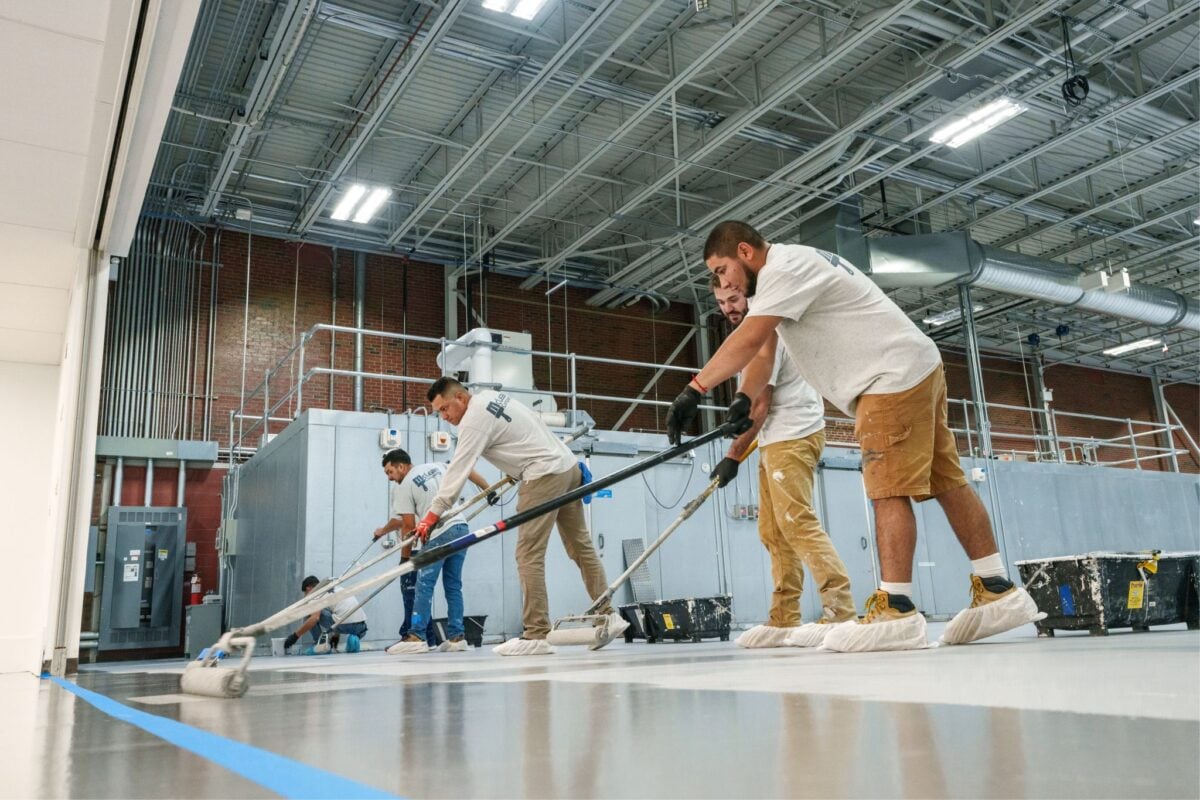
Epoxy moisture vapor emission control primers are the most widely specified moisture management solution for commercial concrete floors. These products are formulated to penetrate the prepared concrete surface, bond within the pore structure, and create a vapor-retarding film that reduces moisture vapor emission to levels that standard floor coating systems can tolerate.
Most commercial epoxy coating systems are rated to tolerate up to 3 to 5 pounds per 1,000 square feet per 24 hours of moisture vapor emission without special treatment. Epoxy moisture vapor emission control primers extend that tolerance, with products rated for emission levels up to 8, 10, or in some cases 15 pounds per 1,000 square feet per 24 hours. The appropriate product for a given project is determined by the measured emission rate on the specific slab.
- Application requires a well-prepared, open concrete surface. A primer applied to a sealed, contaminated, or improperly profiled surface cannot penetrate and bond correctly, which defeats the product’s vapor control function
- Most epoxy moisture vapor emission control primers require a specific overcoat window. The topical coating system must be applied after the primer has cured to tack-free but before it has fully hardened to ensure inter-coat adhesion
- These products are primers, not finished surfaces. They must be followed by the specified topical coating system to provide the surface performance the floor requires
2. Two-Component Epoxy Membrane Systems

For slabs with moisture vapor emission levels above what standard primer products can address, two-component epoxy membrane systems provide a thicker, more robust vapor barrier layer that handles higher emission rates. These systems are applied as a self-leveling or trowel-applied coating that builds to a greater film thickness than a penetrating primer, creating a more substantial physical vapor barrier against moisture migration.
Two-component epoxy membrane systems are appropriate for slabs with emission rates above 10 to 15 pounds per 1,000 square feet per 24 hours, for slabs where the moisture condition is expected to be sustained or variable, and for applications where the topical floor system has particularly strict moisture tolerance requirements. For commercial properties in Boston, MA and surrounding areas with older slab-on-grade construction and no below-slab vapor retarder, this system tier is frequently the appropriate specification.
- Film build for two-component epoxy membrane systems is typically in the range of 10 to 20 mils dry film thickness, compared to 3 to 5 mils for a standard penetrating primer
- Some two-component systems can tolerate emission rates up to 25 pounds per 1,000 square feet per 24 hours when applied at the specified thickness and over properly prepared substrate
- These systems add meaningful cost to the floor project but significantly less than the cost of coating removal and reinstallation that the alternative produces
3. Sheet-Applied Vapor Barrier Membranes for Concrete Subfloors
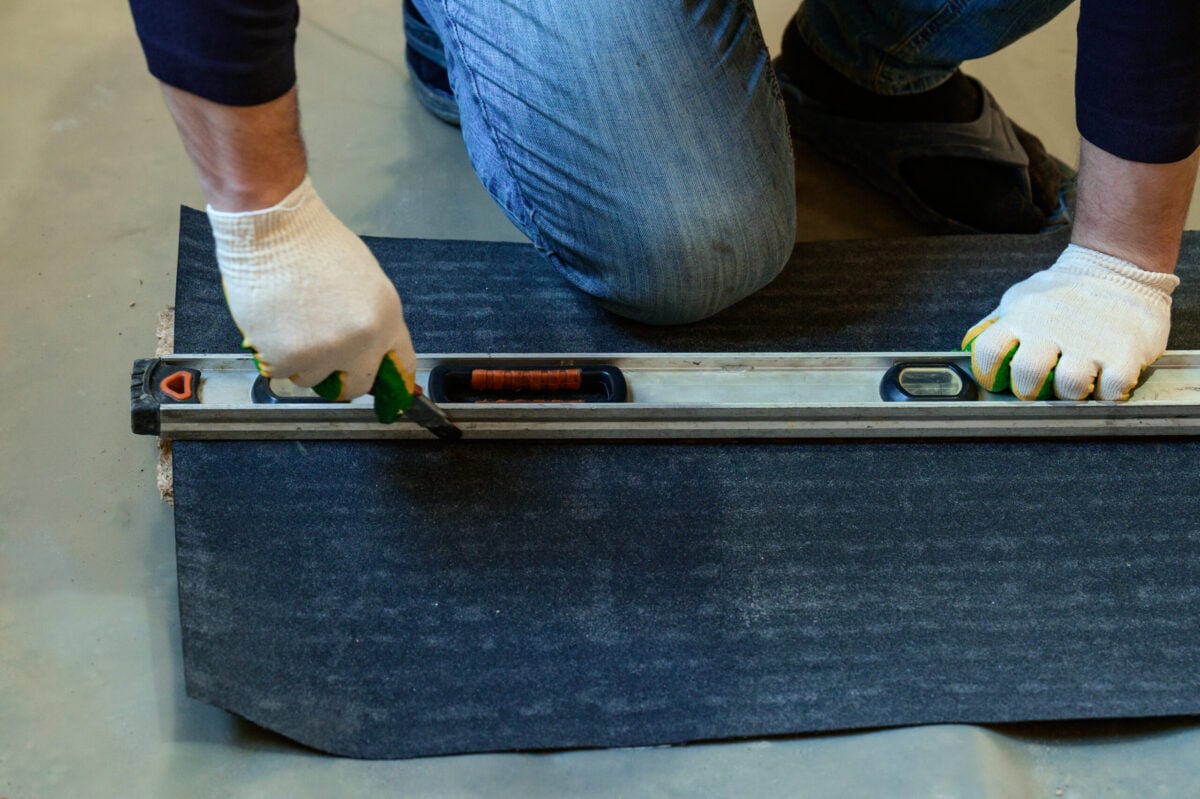
Sheet-applied vapor barrier membranes are physical barrier materials installed between the concrete slab and the topical flooring system. Unlike epoxy-based products that bond to and penetrate the concrete, sheet membranes create a discontinuous layer above the concrete subfloor that vapor must travel through rather than around. They are appropriate for resilient flooring systems, moisture barrier underlayment applications, and certain commercial flooring systems where the topical product requires a clean, flat substrate rather than direct bond to concrete.
Sheet membranes are not appropriate as the sole vapor management solution for topical coating systems like epoxy or polyurethane that require direct mechanical and chemical adhesion to a prepared concrete substrate. Using a sheet membrane under an epoxy coating system produces a floor with no reliable bond to the structural concrete, which creates a different failure mode than the one it is intended to prevent.
- Sheet membrane selection must be matched to the specific flooring system being installed above it. The manufacturer of both the membrane and the topical system should confirm compatibility before the system is finalized
- Seams and penetrations in sheet membranes are potential bypass paths for vapor. Proper lapping, sealing at seams, and detailing at penetrations are critical to the system’s effectiveness
- Sheet membranes add to the finished floor elevation, which affects door hardware clearances, transition thresholds, and any adjacent floor level relationships that must be addressed in the project scope
4. Crystalline Waterproofing as a Moisture Barrier for Concrete Subfloors and Crawl Spaces
Crystalline waterproofing materials applied to the concrete surface react chemically with the concrete matrix to grow insoluble crystals within the capillary pore structure, physically blocking the pore pathways that moisture vapor uses to migrate through the slab. Unlike surface-applied barrier products, crystalline treatment becomes part of the concrete itself and provides vapor reduction that is permanent rather than dependent on film adhesion.
Crystalline products are appropriate as a vapor mitigation strategy on concrete surfaces where the emission rate is elevated but not extreme, where the application chemistry is compatible with the topical flooring system, and where the long-term permanence of the treatment is a priority. They are frequently used on below-grade walls, crawl spaces, and foundations in combination with concrete subfloor vapor mitigation programs.
- Crystalline treatment must be applied to a clean, open, mechanically prepared concrete surface to ensure penetration. Application to sealed or contaminated concrete produces surface-only deposition that does not provide the deep crystal growth the system requires
- The vapor reduction achieved by crystalline treatment varies by slab porosity, treatment density, and the depth of crystal growth achieved. Testing after treatment confirms whether additional mitigation is needed before the topical system is applied
- Some crystalline products are not compatible with all epoxy and polyurethane coating systems. Confirm compatibility with the topical system manufacturer before specifying
How to Test Concrete Subfloors for Moisture Vapor Emission

Moisture vapor emission testing is the foundation of any moisture protection specification. Without test data from the actual slab, product selection is based on assumption rather than measurement, which produces either over-specification that adds unnecessary cost or under-specification that produces the floor failure the process is intended to prevent.
Calcium Chloride Test (ASTM F1869)
The calcium chloride test is the most widely specified moisture vapor emission test method in the commercial flooring industry. The test involves sealing a dish of dry calcium chloride crystals to the prepared concrete surface under a plastic dome for a specified period, then weighing the dish to determine how much moisture vapor it absorbed. The result is expressed in pounds of moisture per 1,000 square feet per 24 hours.
The calcium chloride test measures surface emission and is appropriate for concrete subfloors on grade with standard moisture conditions. It does not measure moisture within the slab depth, which limits its usefulness for slabs with complex moisture dynamics. Three tests per 1,000 square feet with additional tests at any area that shows unusual conditions is the standard protocol for commercial flooring projects.
In-Situ Relative Humidity Probe Test (ASTM F2170)
The in-situ relative humidity probe test measures moisture at 40 percent of the slab depth by drilling and sealing probe holes and allowing them to equilibrate for a specified period before taking relative humidity readings. This method provides information about the moisture condition within the concrete subfloor rather than just at the surface, which is more predictive of long-term moisture vapor emission behavior for thick slabs and slabs with complex moisture sources.
Many flooring manufacturers now require ASTM F2170 testing rather than or in addition to calcium chloride testing as a condition of their product warranty. For commercial projects in Boston, MA and surrounding areas where long-term performance and warranty documentation are priorities, in-situ relative humidity testing is the more defensible standard.
What to Do When Your Vapor Barrier or Moisture Barrier Underlayment Falls Short
A test result that exceeds the tolerance of the specified coating system is not a reason to proceed anyway or to apply extra coats of the standard product. It is a specification trigger that changes the product selection, adds a vapor barrier or moisture barrier underlayment to the scope, or requires selection of a moisture-tolerant coating system that matches the measured emission level.
The correct response to elevated moisture vapor emission is straightforward: select a moisture vapor barrier product rated for the measured emission level, apply it over the properly prepared concrete substrate, allow it to cure fully, confirm that the post-barrier emission level has been reduced to within the topical system’s tolerance, and then proceed with the topical coating application. If the initial vapor barrier or moisture barrier underlayment does not achieve the required reduction, the solution is upgrading to a higher-rated product or system tier, not proceeding with the topical coating and hoping for the best. Documenting each of those steps produces the defensible record that supports warranty claims and provides the facility with evidence that the floor was installed to specification.
Address Moisture Before the Coating Goes Down
Moisture vapor emission is the most common cause of commercial floor coating failure, the most frequently skipped pre-installation step, and the most preventable problem in commercial flooring project management. The cost of addressing it before installation is real but manageable. The cost of failing to address it, paying for coating removal, substrate remediation, and full reinstallation, is several times higher and produces no lasting benefit if the moisture condition is still present when the new system goes down.
McLean Company works with commercial and industrial facility owners across New England to assess concrete slab moisture conditions, specify the right moisture protection approach for each project, and execute installations with the testing rigor and preparation standards that protect the floor system investment. If your facility has a floor project planned or a coating that is showing early signs of moisture-related failure, we can assess the situation and tell you exactly what needs to happen.
Contact us today to schedule a floor assessment and get a clear recommendation on moisture management before your next concrete floor coating project begins.