(978) 774-4330

Brick, concrete block, and stone have built commercial structures that last for generations, but none of those materials are impervious to water. Masonry absorbs moisture, and in a New England climate, that absorbed moisture fuels a cycle of freeze-thaw damage, efflorescence, biological growth, and eventual structural deterioration that is far more expensive to remediate than it would have been to prevent. Masonry waterproofing is the application of materials and methods that stop water at the surface before it can penetrate into the masonry body and begin that cycle. For commercial property owners in Framingham, MA and surrounding areas, where aging masonry building stock faces decades of accumulated moisture exposure, understanding which materials work, which methods apply to your building type, and when waterproofing is actually necessary is the foundation for making a sound maintenance investment. The same care that defines properly specified exterior coating systems on commercial buildings is what makes a masonry waterproofing program perform over the long term.
Here is what you will learn in this guide:
- Why masonry absorbs water and what that absorption does to a commercial building over time
- The primary masonry waterproofing materials and the methods used to apply them
- How to identify interior and exterior signs that your building’s masonry needs waterproofing attention
- What the application process involves and how surface condition affects results
- When Framingham, MA and surrounding areas property owners should prioritize masonry waterproofing as part of their building maintenance program
Why Every Commercial Masonry Waterproofer Needs to Address Moisture Early

Masonry buildings do not fail suddenly. They deteriorate gradually through a process that starts with water absorption and compounds over years as that moisture cycles through the wall assembly, migrates to the surface, deposits mineral salts, freezes and thaws, and gradually breaks down both the masonry units and the mortar that holds them together. By the time the damage is visible as spalling, delamination, or interior staining, it has typically been underway for years.
The economic argument for masonry waterproofing is straightforward. Water penetration that is never stopped at the surface cannot cause the deterioration that requires expensive repair. A waterproofing treatment applied before significant deterioration begins costs a fraction of the structural masonry repair, mortar repointing, and interior remediation that deferred moisture management eventually produces. For commercial building owners in Framingham, MA and surrounding areas managing brick, porous concrete, or stone structures, the question is not whether waterproofing is worth doing. It is which material and method are appropriate for the specific building and condition. Here is what effective masonry waterproofing protects against:
- Freeze-Thaw Damage: Water absorbed into masonry pores freezes and expands in winter temperatures, progressively fracturing the masonry unit and mortar from within. Waterproofing stops the absorption cycle before freeze-thaw action can begin.
- Mold and Mildew Growth: Sustained surface moisture enables mold and mildew growth on exterior and interior walls. Stopping water penetration eliminates the moisture source that allows these organisms to establish and spread.
- Biological Growth: Algae, lichen, and mildew establish themselves on masonry surfaces that retain moisture. These organisms retain additional moisture against the surface, accelerating deterioration and creating the cleaning and remediation costs that follow.
- Mortar Joint Deterioration: Mortar is more permeable than masonry units and more vulnerable to chemical attack from dissolved salts and freeze-thaw cycling. Water infiltration concentrated at mortar joints accelerates the repointing cycle and, in severe cases, destabilizes the masonry assembly.
- Interior Water Damage: Masonry that transmits visible moisture to the interior of the building creates conditions for insulation degradation, drywall damage, mold growth, and the building systems failures that follow sustained interior moisture exposure.
5 Masonry Waterproofing Materials, Methods & How They Compare
Masonry waterproofing is not a single product category. Different materials work through fundamentally different mechanisms, and the right choice for a given building depends on the masonry type, the moisture condition being addressed, the desired visual outcome, and the performance requirements of the application. The methods below represent the primary approaches used on commercial masonry buildings across New England, covering both interior exterior applications and dedicated exterior-only systems.
1. Penetrating Silane Sealers
Silane sealers penetrate deeply into the masonry pore structure and react chemically with the silica in the substrate to form a hydrophobic barrier within the pores themselves. Because the treatment occurs inside the masonry rather than on its surface, silane sealers do not change the visual appearance of the treated surface, do not create a film that can peel or delaminate, and allow the masonry to continue breathing while blocking liquid water entry. They are appropriate for new or unpainted surfaces and bare masonry where a film-forming coating is not desired.
Silane is the most appropriate choice for dense, hard substrates including existing concrete, hard brick, and granite where deep penetration is needed to reach below the depth of carbonation or contamination that might prevent a larger-molecule product from penetrating effectively. For historic commercial buildings in Framingham, MA and surrounding areas where appearance preservation is a priority, silane provides meaningful waterproofing performance without altering the character of the masonry surface.
- Silane molecules are small enough to penetrate deeply into dense, low-porosity substrates where siloxane and other larger-molecule products cannot reach adequate depths
- Silane treatment is colorless and does not change the sheen, texture, or color of the treated masonry surface, making it ideal for bare masonry and new or unpainted surfaces
- Effective service life for silane treatments on commercial masonry typically ranges from five to ten years depending on substrate porosity, UV exposure, and the severity of wind-driven rain exposure
2. Siloxane Sealers
Siloxane sealers work through the same hydrophobic chemistry as silane but have larger molecules that penetrate less deeply into the substrate. They are well-suited for more porous concrete, concrete pavers, softer brick, stucco, and natural stone where their broader surface coverage provides effective moisture protection without requiring the deep penetration that denser substrates demand. On new concrete and porous concrete surfaces that have not been previously sealed, siloxane products perform particularly well because the open pore structure allows full product penetration at standard application rates.
Siloxane treatments are vapor permeable and invisible after application, which makes them appropriate for historic masonry and buildings where appearance must be preserved. They are available in both water-based and solvent-based formulations, with solvent-based products providing deeper penetration and better performance on contaminated or partially sealed substrates.
- Siloxane is the preferred penetrating sealer for concrete masonry units, concrete pavers, softer brick, and natural limestone or sandstone where porosity is higher and penetration depth requirements are lower than for dense existing concrete or hard brick
- Silane-siloxane blend products are increasingly specified because they combine the penetration depth of silane with the broad surface coverage of siloxane, making them effective across a wider range of substrate types than either product alone
- Application rate for penetrating sealers must match the substrate porosity. Overapplication on low-porosity substrates leaves excess product on the surface that can create a hazy appearance
3. Elastomeric Coating Systems

Elastomeric waterproofing coatings form a thick, flexible film on the masonry surface that creates a continuous waterproof membrane rather than treating the masonry from within. These systems are appropriate when the masonry surface has hairline cracking, surface porosity, or a history of water penetration that penetrating sealers cannot fully address, and when a surface film is acceptable or desirable from an appearance standpoint. They can be applied over both painted surfaces and existing paint in sound condition, as well as directly to new or unpainted surfaces that have been properly prepared.
Applied at dry film thicknesses significantly greater than standard exterior paint, elastomeric systems can bridge hairline cracks and maintain their waterproof integrity through the thermal cycling that causes rigid coatings to crack and fail. For commercial masonry buildings in Framingham, MA and surrounding areas with moderate surface cracking and a history of wind-driven rain infiltration, elastomeric coatings are often the most effective available solution. They can be applied by airless sprayer or a thick-nap roller on large commercial wall areas, which makes them efficient to apply at scale compared to brush-only methods.
- Elastomeric systems are vapor permeable in most formulations, meaning the wall can still breathe while the surface blocks liquid water entry
- Available in a wide range of colors, elastomeric coatings allow waterproofing and repainting to be accomplished in a single interior exterior application where applicable, reducing project cost compared to separate scopes
- The crack-bridging performance of elastomeric coatings is maintained as long as the coating film remains flexible. UV degradation over time reduces flexibility, which is why UV-stable acrylic elastomeric formulations are preferred for exterior application on commercial buildings
4. Crystalline Waterproofing Systems for Concrete Masonry
Crystalline waterproofing systems work through a fundamentally different mechanism than surface or penetrating treatments. Applied as a slurry to the entire surface area being treated, crystalline materials react with the calcium hydroxide and water in the concrete or masonry to grow insoluble crystals within the capillary pores of the substrate. These crystals permanently block the pore structure against water penetration and are particularly effective in below-grade applications where hydrostatic pressure from groundwater is a factor.
The unique advantage of crystalline systems is that they become a permanent part of the masonry matrix rather than a surface treatment or penetrant that can be depleted over time. They are also self-sealing to a degree because the crystal growth reaction reactivates in the presence of moisture, which allows the system to address new hairline cracks that develop after treatment. Crystalline systems are most effective on concrete and concrete masonry units and are the standard specification for below-grade basement walls and grade basement walls where hydrostatic pressure rules out conventional coating approaches.
- Crystalline waterproofing is the appropriate specification for below-grade masonry walls, grade basement walls, retaining walls, elevator pits, and other applications where hydrostatic pressure is a factor and conventional coatings would fail under sustained water pressure from behind
- The permanent bonding of crystalline products to the masonry substrate makes them appropriate for situations where long-term surface treatment or reapplication is not practical
- The entire surface must be clean, sound, and free of contamination for the crystal growth reaction to proceed correctly. Loose concrete and loose paint must be fully removed before application
5. Integral Water Repellents for New Masonry
For new construction or masonry restoration projects, integral water repellents can be specified as admixtures in mortar or concrete mix that provide waterproofing from within the material rather than as a post-application treatment. These silicone or stearate-based admixtures reduce the capillary absorption of the finished masonry, providing long-term moisture resistance without any surface treatment requirement.
Integral water repellents are most relevant during construction or major repointing projects rather than as a maintenance solution for existing masonry, but they are worth understanding as part of a comprehensive masonry waterproofing program for new commercial buildings.
- Integral admixtures do not eliminate the need for surface waterproofing on the finished masonry but reduce the moisture absorption that surface treatments are required to manage
- Mortar with integral water repellent admixtures provides enhanced protection at the joint locations that are typically the most permeable element of a masonry assembly
- Specifying integral water repellents in conjunction with a surface penetrating sealer on new concrete and new masonry provides a defense-in-depth approach that outperforms either treatment alone
Interior and Exterior Signs Your Masonry Needs Waterproofing Attention
Identifying when masonry waterproofing is needed before visible damage develops is what separates proactive building maintenance from reactive remediation. Several observable conditions, both on the interior and exterior of the building, signal that the masonry is absorbing more water than it should and that a waterproofing intervention is warranted.
- Efflorescence: White crystalline deposits on the masonry surface are a reliable indicator of active moisture migration through the wall. The deposits themselves are not structurally damaging, but they are the visible evidence of the water penetration that is causing the problem.
- Visible Moisture and Staining After Rain: Masonry that absorbs water darkens visibly after rain events and remains dark for extended periods as the moisture evaporates. Sections with visible moisture significantly longer than adjacent areas indicate locally elevated porosity or existing entry points.
- Mold and Mildew Growth: Persistent mold and mildew growth on exterior masonry surfaces is a reliable indicator that the surface is retaining moisture long enough to support biological activity. Treating the mold and mildew growth without addressing the underlying moisture retention will allow it to return on the same timeline.
- Flaking Concrete and Mortar Joint Erosion: Flaking concrete and mortar joints that are recessed, crumbling, or have visible gaps represent both a moisture entry point and an indicator that the assembly has been experiencing freeze-thaw cycling. Repointing before waterproofing is typically required in this condition.
- Interior Staining or Damp Spots: Staining on interior wall surfaces, particularly on exterior-facing grade basement walls and below windows, indicates that moisture is transmitting through the masonry assembly into the building interior.
- Active Water Leaks: Active water leaks at wall penetrations, window perimeters, or through the masonry face itself require immediate attention. Active water leaks indicate that the building envelope has already been compromised and that waterproofing needs to be combined with repair of the infiltration source.
Surface Preparation: What Determines Whether Waterproofing Works

The performance of any masonry waterproofing system is determined largely by the condition of the surface at the time of application. A penetrating sealer applied to contaminated masonry cannot penetrate effectively. An elastomeric coating applied over loose concrete or flaking concrete will delaminate on the same timeline as the material beneath it. The preparation scope is not optional, and its cost is proportional to the condition of the masonry before work begins. Air and surface temperatures at the time of application also matter significantly. Most waterproofing products have minimum and maximum air and surface temperature requirements that must be met during application to achieve proper penetration and cure. Applying product outside those temperature ranges produces results that do not match the manufacturer’s performance specifications regardless of how well the surface was prepared.
Cleaning and Mildew Removal
All masonry surfaces to be waterproofed must be free of contamination including mold and mildew growth, efflorescence, oil, old paint that is no longer sound, and any other material that would prevent the waterproofing product from contacting the substrate. To remove mildew stains effectively before sealing, a dilute bleach solution or commercial mildew removing product should be applied to the entire surface area, allowed to dwell, scrubbed, and rinsed thoroughly. Pressure washing after chemical treatment is the standard cleaning method for most commercial masonry. Efflorescence requires specific chemical treatment to dissolve and remove the mineral deposits rather than simply dispersing them.
Removing Deteriorated Coating and Patching
It is essential to remove deteriorated coating prior to applying any new waterproofing system. Applying new product over failing or peeling existing coatings bonds the new system to the deteriorated layer rather than to the masonry substrate, producing a repair that fails on the same timeline as the coating beneath it. Areas of flaking concrete or loose concrete must be properly patched with compatible repair mortar and allowed to cure before the waterproofing system is applied over them. When using a nap roller for elastomeric application, the roller must be clean and the correct nap thickness for the product being used, as the wrong nap thickness affects coverage rate and film build.
Wire Brushing and Mechanical Preparation
In areas where existing paint is peeling, where old paint is incompatible with the new system, or where mold and mildew growth has left behind residue after chemical cleaning, wire brushing provides the mechanical action needed to remove deteriorated coating prior to application. Wire brushing followed by vacuuming or blowing off the debris leaves a clean surface profile that penetrating sealers can enter and coating systems can bond to. For larger areas, mechanical grinding or shot blasting may be more efficient than manual wire brushing.
Application Sequence
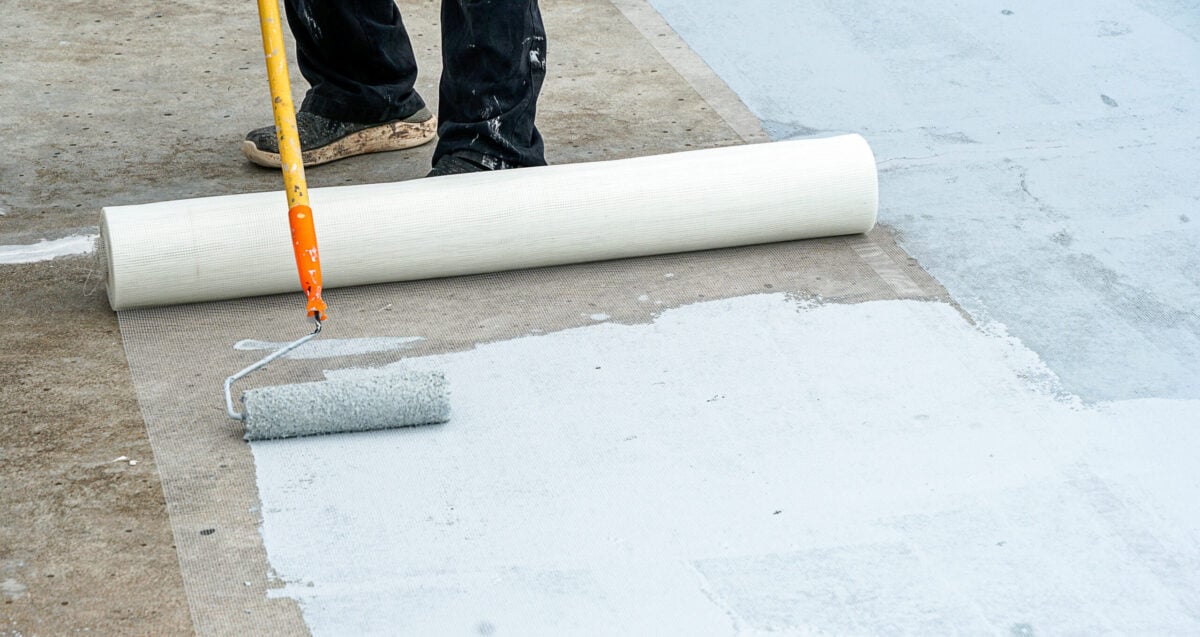
For coating systems applied by airless sprayer or nap roller, the first coat is worked into the entire surface to establish the base bond and seal the most porous areas uniformly. Two coats are required for most elastomeric and film-forming waterproofing systems to achieve the specified dry film thickness that delivers the product’s rated waterproofing performance. Applying only one coat reduces film build and proportionally reduces the waterproofing performance of the system. The second coat is applied after the first coat has reached the manufacturer’s specified recoat window. If it becomes necessary to re apply product over a section that was missed or inadequately covered, the surface condition of that section should be assessed before re-application to confirm it is still clean and bondable.
Protect Your Masonry Before the Next Season
Masonry waterproofing is most valuable when it is applied before significant deterioration has occurred, not after the freeze-thaw damage, flaking concrete, mold and mildew growth, and structural degradation that deferred moisture management produces. The cost differential between a preventive waterproofing program and a remediation program after years of unmanaged moisture infiltration is significant on any commercial building of meaningful scale.
McLean Company works with commercial property owners and facility managers across New England to assess masonry conditions, specify the right waterproofing system for each building’s substrate type and moisture condition, and apply the treatment with the surface preparation standards that allow it to perform as specified. If your building’s masonry is showing signs of moisture infiltration or has not been waterproofed in more than a decade, we can assess it and tell you what it needs.
Contact us today to schedule a masonry assessment and get a waterproofing recommendation built around the actual condition and requirements of your building.